HISTORY
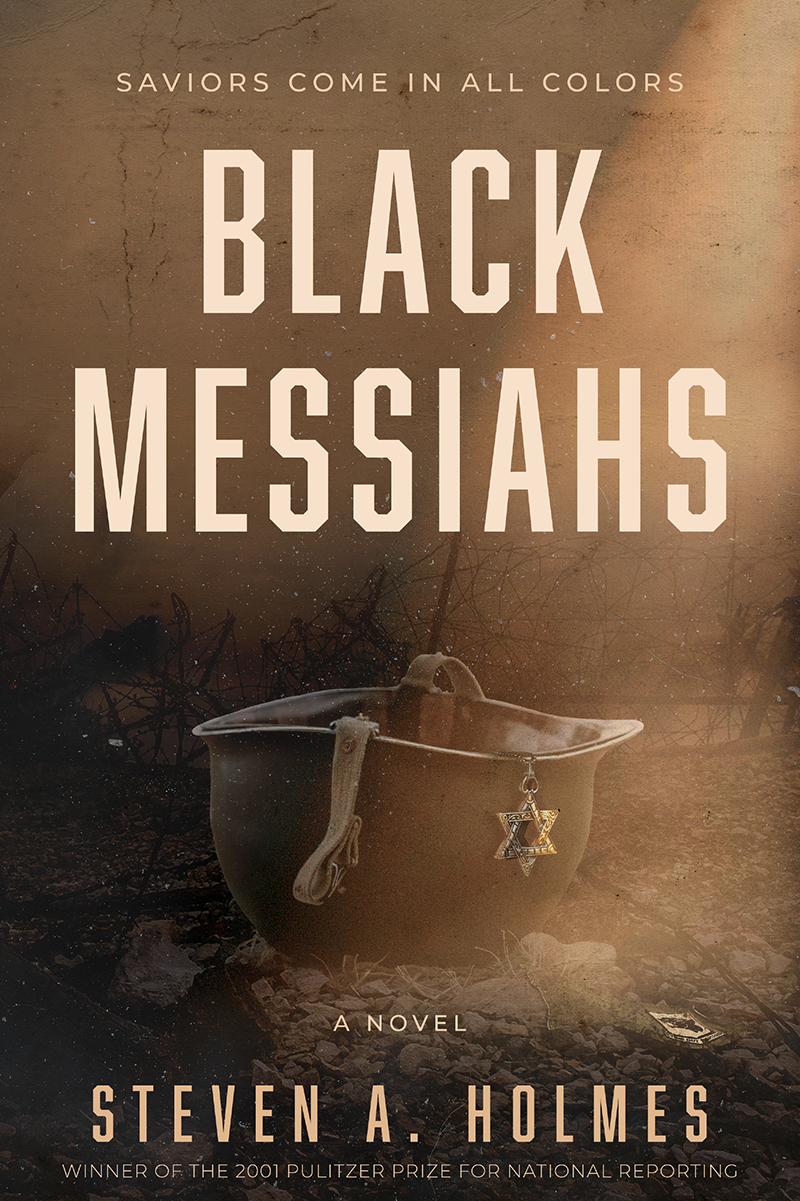
Black Messiahs
Born from a true story of rescue and redemption, Black Messiahs intertwines the lives of Black soldiers and a young Jewish survivor in World War II, revealing how courage, faith, and shared struggle can transcend even humanity’s darkest hours.

In December 1941, following the Japanese attack on Pearl Harbor, the United States entered World War II. This event elicited diverse responses from individuals across the globe. In Chicago, Amos Johnson and subsequently his younger brother Samuel enlisted in the military. As members of a segregated Army, the Johnson brothers, along with other Black soldiers, encountered significant challenges: they contended with systemic racism within America that questioned their capabilities and subjected them to harassment and violence both on and off military bases. Simultaneously, they faced the formidable German army on the battlefield.
Meanwhile, in Poland, David Cohen—a young Jewish boy—found renewed hope for survival from Hitler’s murderous regime upon hearing of the American entry into the war. For four years, while in a series of brutal concentration camps, he maintained the belief that American forces would ultimately come to his aid. Unbeknownst to him, those who would eventually rescue him were Black soldiers, who themselves had only recently been permitted to fight against Nazi oppression due to prevailing racial discrimination in the United States.
The forthcoming novel “Black Messiahs,” scheduled for release on May 19, narrates the interconnected journeys of these individuals. It offers a comprehensive account of courage, resilience, adaptability, and perseverance amidst violence, racism, genocide, and personal hardship. The narrative also prompts reflection on critical historical questions, such as how many more Jews might have been saved during the Holocaust if the United States had fully utilized all its human resources from the outset, rather than restricting for years African American participation in the fight against the Nazis. Furthermore, the novel highlights the shared struggles of Black and Jewish communities—a connection often overlooked in contemporary discussions about race.
In addition to its main narratives, “Black Messiahs” also contains a host of intriguing minor characters and themes, including family dynamics, sibling rivalry, romance, Jewish resistance, several strong female characters, a gay Black soldier struggling with the homophobia of the 1940s and several real historical people and events.
This novel was inspired by the remarks of Anthony Blinken when he was named by President-elect Joe Biden in November 2020 to be Secretary of State. At the press conference announcing his nomination, Blinken told the story of his stepfather, Samuel Piser who, as a young Polish Jew survived internment in a string of concentration camps and was rescued at the end of the war by a Black tank battalion.
Watching this on television, the thought hit me, “That’s my novel!”
“Black Messiahs belongs in the personal library of every World War II historian and aficionado.”
– Major General Peter J. Gravett , US Army (Retired)
Book Excerpts
Chapter 13 – Sammie
[African American soldiers in England during the Second World War] [Photograph]. (ca. 1944). Equal Justice Initiative, Montgomery, AL, United States. https://eji.org/
Chapter 33 – Isaac
[Jewish partisans entering the liberated city of Vilna, Lithuania]. (1944, July). Yad Vashem Photo Archives (Reference No. 1644/101), Jerusalem, Israel. https://www.yadvashem.org/holocaust/this-month/july/1944.html
Chapter 61 – Amos
European School. (2019, February 13). [World War Two silhouettes of three soldiers with bayonets] [Photograph]. Fine Art America. fineartamerica.com
Book Reviews
Holmes’ historical novel explores Black GIs’ struggles in World War II.
In Holmes’ gripping wartime tale, the oppressions of bigotry exact a fearful psychic toll on American soldiers of color and on a young Polish boy in a concentration camp. The story focuses on siblings Sammie and Amos Johnson, who enlist for different reasons. For Amos, the conflict offers a way of burnishing his leadership skills, which have often been stifled by “often incompetent White foremen” at his steel mill job. For Sammie, joining the 761st Tank Battalion promises an “adventure” that will bring him face to face with the horrors of Nazi concentration camps—a story thread that’s vividly explored through the tale of David Cohen, an 11-year-old Jewish boy trapped in Poland’s Bialystok ghetto. After a futile uprising against the ghetto’s Nazi enforcers, David endures a series of increasingly hellish camp confinements that force him to numb all emotions in order to survive: “The last time he remembered weeping was when the Gestapo had led his father away.” This emotional strategy comes naturally to Black soldier Lonnie West of the 761st—a gay man who’s subjected to endless cruelties. He dreams of becoming a teacher, so students will accept differences “without identifying what differences I’m talking about,” he tells Sammie in one of the novel’s most moving scenes. “If I can do that, that’ll be a start.” What emerges is a plea for tolerance that strikes an impressive contrast with the evils the characters experience on the front lines. Overall, Holmes has done a yeoman’s job of weaving all of these themes into a truly engaging, richly crafted narrative, maintaining a high standard for modern war fiction.
A sensitive and searing story of confronting evil at home and abroad.
– Kirkus Reviews
Articles
Origin of an Idea
[Close-up of muddy caterpillar tracks on a military tank]. (2025). Aerospace & Defence. https://www.aerospace-and-defence.com/czech-republic-orders-leopard-2-a8-a-e27087c306ae19b330a989deeb4220f8/
Erasing Black History
[Photograph of the rows of white crosses and memorial tower at the Netherlands American Cemetery and Memorial in Margraten, Netherlands]. (n.d.). American Battle Monuments Commission. https://www.abmc.gov/Netherlands
Lonnie
U.S. Army Signal Corps. (1944, November 5). [Corporal Carlton Chapman of the 761st Tank Battalion standing before his M4 Sherman tank near Nancy, France] [Photograph]. National Archives and Records Administration (Reference No. SC 196105-S), Washington, D.C., USA.