
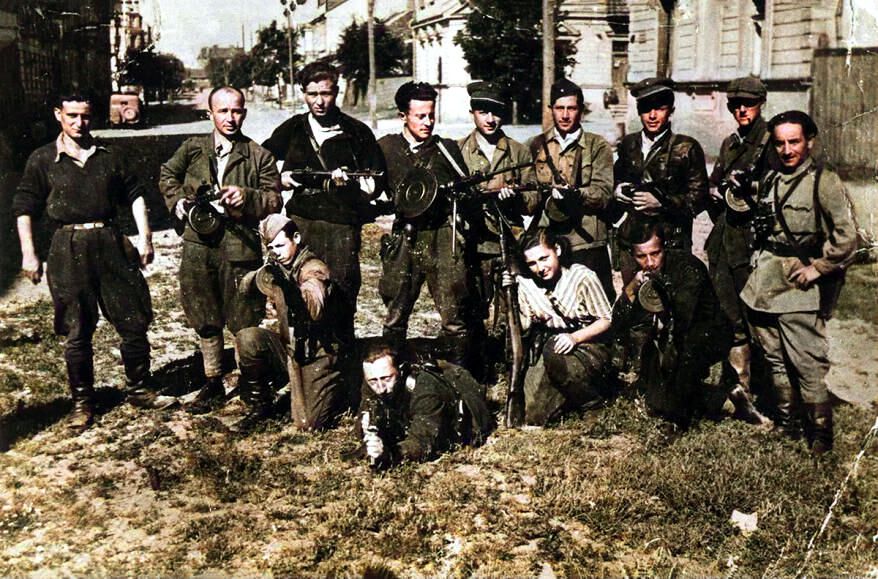
November 1943
Something didn’t seem right to David as he walked to his early morning shift at the shoe factory. There seemed to be a lot of people on the street—more than usual for this hour of the day. Many were walking hurriedly with worried looks on their faces. Most carried luggage.
Almost all appeared to be heading away from the ghetto’s outskirts and toward its center. David decided to go the opposite way—toward the barbed wire encirclement—to see what was going on. What he saw when he got there sent chills down his spine. There were German soldiers everywhere. Lots of them. Many had automatic weapons, and they were lined up to his left and to his right as far as he could see.
They appeared like they were getting ready to invade.
David turned on his heels and sped off, running as fast as he could back to his apartment. “Feter! Feter!” he cried out as he bounded breathlessly into the small flat. “Uncle! Many soldiers are coming! Many!” A feeling of dread washed over Isaac, who was finishing a cup of coffee before setting off to work. A large contingent of troops entering the ghetto could only mean one thing—the Germans were carrying out a mass deportation. They’d done the same thing back in February when they’d sent thousands of Jews from Bialystok to death camps. Could it be happening again? He didn’t want to jump to that conclusion based on the words of an excited thirteen-year-old boy. He had to see for himself. He followed David back into the street. They headed toward the perimeter where David had spotted the soldiers. When they got to the barbed wire marking the ghetto’s boundary, Isaac abruptly stopped.
“Aoy drek!” he cursed.
At that moment, a voice over a loudspeaker pierced the morning air. “Jews of Bialystok,” it said. “You are ordered to report immediately to the main square for transport! Only bring what each person can carry in one suitcase.”
As the message repeated, Isaac shook his head. How could this be happening? Things were going so well. The Germans had suffered a catastrophic defeat at Stalingrad. The British and Americans had landed in Sicily. The Germans were in retreat. The Allies’ bombing campaign had knocked out many factories in Germany, creating more demand for goods made in Bialystok. Hadn’t Barasz received assurances recently that the ghetto was safe? There was a new feeling of optimism. People were even having weddings again.
Just last month, he’d been part of a minyan observing David reciting passages from the Torah for his bar mitzvah. As he stood with nine other Bialystok men, including his friend Ephraim Barasz, watching his nephew, whom he now thought of as a son, Isaac had felt more than just pride; he’d felt a warm glow of optimism. David is going to make it, he said to himself at the time. We all will.
Now this.
Isaac turned to his nephew.
“David, run back to the apartment and tell your mother and your Aunt Ruth to do what I instructed them to do. Remember what I told you many times. If you hear lots of gunfire, go quickly to the area on the far side of the factories. There are gaps in the fence there. Get through them and try to make it to the forest. Try to find the partisan fighters. They will keep you safe. Hurry!”
As David took off, Isaac headed to a neighborhood where Mordechai Tenenbaum was probably hiding. If this is really happening—and it looked like it was—it had to be resisted. We’re not having huge numbers of people sent to the death camps again, Isaac said to himself. Not this time. Not without a fight.
Read what happens next in Black Messiahs…